Frisco E-Bike

Buyer guide · updated 2026-08-22

Best Long Range E-Bikes

Range claims are the least honest numbers in the e-bike business. The figure on the box is usually measured at the lowest assist level, with a light rider, on flat ground, in mild weather, and it is routinely double what a real rider sees at the assist level they actually use. The only number you can trust is battery capacity in watt-hours, and the rough rule is 15 to 25Wh per mile depending on rider weight, speed, tires and terrain. A 672Wh pack is a 30 to 40 mile bike at moderate assist; a 960Wh pack is a 45 to 60 mile bike; dual batteries push past that.

This guide is for riders who regularly go 40 miles or more between charges: long suburban commutes, all-day greenbelt rides, trail days with no outlet, or simply not wanting to think about charging. Our picks are the biggest single batteries sold through Amazon and direct brands, the dual-battery cargo bike, the long-range folder and the commuter with the best range per dollar. All of them are heavy, because big batteries are heavy.

Affiliate Disclosure: We may earn a commission when you purchase through links on this page, at no additional cost to you. As an Amazon Associate I earn from qualifying purchases. Learn more

Our picks at a glance

  1. Best overall

    Segway Xafari All-Terrain E-Bike

  2. Best value

    Himiway Zebra Fat Tire E-Bike

  3. Best for speed (verify support first)

    Juiced Bikes RipCurrent S Fat Tire E-Bike

  4. Best dual-battery option

    Lectric XPedition 2.0 Cargo E-Bike

  5. Best long-range folder

    Engwe Engine Pro Folding Fat Tire E-Bike

  6. Best long-range commuter

    Ride1Up 700 Series Commuter E-Bike

How we picked

Range is the headline dimension and we score it on battery watt-hours adjusted for the bike's weight, tires and the speed it encourages; a 936Wh pack on a 26x3 bike scores higher than the same pack on a 26x4 bike. Value compares watt-hours and hardware per dollar and gives credit for dual-battery options. Fit for purpose asks whether the bike suits long rides: comfort, geometry and how it feels at mile 40.

Features counts sensor type, suspension, hydraulic brakes, lighting and app features. Weight is scored because long-range bikes are the heaviest category and it affects handling and loading. Serviceability rewards brands with support networks and penalizes uncertainty. Safety counts braking for a heavy bike at speed and battery certification where published.

PickRangeValueFit for purposeFeaturesWeightServiceabilitySafety
Segway Xafari All-Terrain E-Bike5/53/55/55/51/53/54/5
Himiway Zebra Fat Tire E-Bike5/54/54/53/51/53/54/5
Juiced Bikes RipCurrent S Fat Tire E-Bike5/53/54/54/51/51/53/5
Lectric XPedition 2.0 Cargo E-Bike5/55/53/54/51/53/54/5
Engwe Engine Pro Folding Fat Tire E-Bike4/54/53/54/51/52/53/5
Ride1Up 700 Series Commuter E-Bike3/55/54/54/52/53/54/5
  • Range: Battery capacity relative to the bike's weight, tires and typical use. We score usable real-world range, not the brochure number.
  • Value: What you get for the price band, counting what is included versus what you will have to add (fenders, rack, lights, larger battery).
  • Fit for purpose: How well the bike suits the job this guide is about, judged on geometry, tires, motor tuning and the equipment it ships with.
  • Features: Brakes, sensor type, suspension, lights, fenders, rack, display and app features, weighted by how much they matter for this use.
  • Weight: Overall bike weight and what it means for handling, stairs, car racks and pedaling home with a dead battery. Lighter scores higher.
  • Serviceability: How easy it is to get parts, warranty help and local shop service. Dealer brands score high; email-only brands score low.
  • Safety: Braking power, lighting, payload rating relative to the use, and whether the battery and charger carry UL or similar certification.
Rider on an electric bicycle on a road

1. Best overall

Segway Xafari All-Terrain E-Bike

The Xafari pairs a 936Wh battery with a torque sensor, a 750W motor, 26x3 tires, a suspension fork and seatpost, hydraulic brakes and built-in GPS tracking and alarm. The 3-inch tires roll better than 4-inch fat tires, so it gets more miles from its battery than the fat bikes here. It is very heavy, and Segway's e-bike parts supply is less proven than Rad's or Aventon's.

Pros

  • 936Wh battery
  • Torque sensor and hydraulic brakes
  • Suspension fork and seatpost

Considerations

  • Heavy
  • Less established service network
  • Premium price for a hub bike
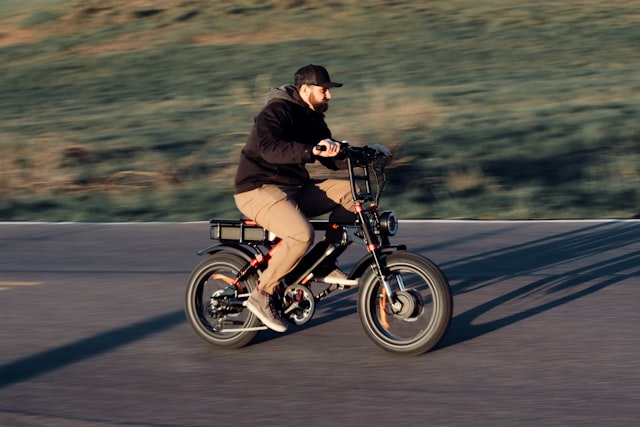
Man riding an e-bike down a street

2. Best value

Himiway Zebra Fat Tire E-Bike

The Zebra's 960Wh battery is the largest single pack on this list, and it comes with a 750W motor, hydraulic brakes, a 400 lb payload rating and two frame styles at a price below the Xafari. The 26x4 tires cost some range on pavement and the cadence sensor is less refined. Support is online only.

Pros

  • 960Wh battery
  • Hydraulic brakes
  • 400 lb payload

Considerations

  • Heavy
  • Assist less refined
  • No dealer network
Rider on an electric bicycle

3. Best for speed (verify support first)

Juiced Bikes RipCurrent S Fat Tire E-Bike

The RipCurrent S built its reputation on a 52V battery close to 1,000Wh, a 28 mph top speed, a torque sensor and a strong Bafang motor, and it remains one of the longest-legged fast fat bikes. The caveat is real: Juiced went through a shutdown and ownership change in 2024 and 2025, so confirm current warranty and parts support before buying, and know that 52V chargers and packs are less common than 48V.

Pros

  • Nearly 1,000Wh battery
  • Torque sensor and strong motor
  • Hydraulic brakes

Considerations

  • Brand support uncertainty
  • Heavy
  • 52V ecosystem is smaller
Cyclist on a cargo bike

4. Best dual-battery option

Lectric XPedition 2.0 Cargo E-Bike

With two 672Wh packs the XPedition 2.0 carries more energy than any single-battery bike here, and it does it on a cargo frame with a 750W motor, a torque sensor, hydraulic brakes and a 450 lb payload rating. It is a cargo bike, so it is long and heavy and rides like one. For a rider who wants to carry things and never think about charging, nothing else near its price comes close.

Pros

  • 450 lb payload
  • Torque sensor on the 2.0
  • Dual-battery option

Considerations

  • Utilitarian finish
  • Heavy
  • No dealer network
Rider on an electric bicycle

5. Best long-range folder

Engwe Engine Pro Folding Fat Tire E-Bike

The Engine Pro's 768Wh battery is larger than almost any other folder's, and it comes with full suspension, a 750W motor and hydraulic brakes. It is among the heaviest folders sold, so the fold is for storage only, and support is online. For a folder that can do a 40 mile day on rough roads it is the pick.

Pros

  • Large 768Wh battery
  • Full suspension and hydraulic brakes
  • Strong 750W motor

Considerations

  • Among the heaviest folders
  • Bulky even folded
  • Support is remote
Rider on an electric bicycle on a paved road

6. Best long-range commuter

Ride1Up 700 Series Commuter E-Bike

The 700 Series is not the biggest battery here at 720Wh, but on 27.5-inch commuter tires it goes farther per watt-hour than any fat bike, and it is a complete Class 3 commuter with hydraulic brakes, fenders, rack and lights. For a 15 to 20 mile each-way commute it is the most practical bike on this list. Cadence sensor and online-only support are the trade-offs.

Pros

  • Strong 750W motor and 720Wh battery
  • Hydraulic brakes
  • Complete commuter kit

Considerations

  • Assist feel is less refined
  • Heavy to lift
  • No dealer network

Affiliate Disclosure: We may earn a commission when you purchase through links on this page, at no additional cost to you. Details

Advertisement

How to read a range claim

Ignore the mileage number and find the watt-hours. If the listing only gives volts and amp-hours, multiply them: 48V x 20Ah is 960Wh. Then divide by your consumption. A light rider at low assist on a commuter might use 12Wh per mile; a 220 lb rider at high assist on a fat bike in a headwind might use 30. Most people on most bikes land at 15 to 25. That makes a 672Wh pack a 27 to 45 mile battery, a 960Wh pack a 38 to 64 mile battery.

Throttle-only riding roughly doubles consumption. Hills, heat, cold, low tire pressure and fat tires all add to it. Range also shrinks as the battery ages; plan on 20 percent less after a few hundred cycles. If you need 40 real miles, buy a bike rated for 70 on the box, or buy watt-hours.

One big battery or two?

A single large pack (Xafari, Zebra, RipCurrent) is simpler: one charger, one thing to carry inside, one slot. The packs are heavy, often 9 to 11 lb, and a replacement is expensive. Dual-battery bikes (XPedition, Tern GSD) split the weight, let you ride on one pack when you do not need both, and let you replace packs one at a time. They also cost more up front if you buy both packs.

For most riders one big pack is the right answer. If you have a cargo bike or ride very long days, dual batteries are worth it. Either way, the charger matters: a 3 or 4 amp charger refills a 960Wh pack in roughly 5 to 6 hours; the 2 amp chargers some bikes include take much longer.

Tires, speed and the range you throw away

The biggest lever after battery size is rolling resistance. A 26x4 fat tire at 15 psi can cost 20 percent or more of your range compared with a 2-inch commuter tire at 50 psi. Speed is the next one: air drag rises with the square of speed, and riding at 25 mph uses far more energy per mile than 18 mph. A torque sensor helps because it encourages you to pedal rather than ride the throttle.

If range is your top priority and you ride pavement, a commuter with a 720Wh pack (700 Series) may go as far as a fat bike with 900Wh. If you need fat tires for where you ride, buy the big battery and accept the hit.

Batteries, heat and long-term health

Big batteries are expensive, so treat them well. Store and charge indoors at room temperature; a Texas garage in summer is the worst place for a lithium pack. Avoid leaving the pack at 100 percent for weeks; 40 to 80 percent is the happy range for storage. Let a hot battery cool after a long ride before charging, and never charge a pack that is swollen, hot to the touch or smells burnt; stop and get an E-Bike Assessment or a professional opinion.

Use only the charger that matches the pack's voltage and connector. This matters especially for 52V bikes like the RipCurrent, where the wrong 48V charger will not fully charge and a wrong-voltage charger can damage the pack or worse.

Alternatives and who should skip this category

If you ride 20 to 30 miles a day, you do not need a long-range bike; a commuter with a 670 to 720Wh pack (Aventon Level.2, Ride1Up 700 Series, Velotric Discover 1) covers that with margin. If you want the refinement of a mid-drive and a large integrated battery with dealer service, the Specialized Turbo Vado 4.0 with its 710Wh pack is the dealer-sold reference. And for trail days, a spare battery in a pannier is a cheaper way to double range than a bigger bike.

Already own an e-bike that is acting up?

Before replacing it, find out what is actually wrong. An E-Bike Assessment gives you a clear report and next steps.

Frequently asked questions

Which e-bike has the longest range?

Among our picks, the Himiway Zebra (960Wh) and Segway Xafari (936Wh) have the largest single packs; the Juiced RipCurrent S is close to 1,000Wh at 52V; the Lectric XPedition 2.0 with dual batteries carries about 1,344Wh. Real range depends on rider, speed and tires.

How far will a 960Wh battery go?

Roughly 40 to 60 miles at moderate pedal assist for an average rider on mixed surfaces, less on throttle, on fat tires or at Class 3 speeds, and more for a light rider on a commuter at low assist.

Is a second battery better than a bigger one?

A second battery in a pannier doubles range on any bike and is often cheaper than stepping up to a bigger bike. Dual-battery bikes with two slots are the tidiest version of that. A single big pack is simplest if it covers your needs.

Does 52V give more range than 48V?

Not by itself; range is watt-hours. 52V systems run a little more efficiently and feel quicker, but the trade-off is a smaller ecosystem of chargers and replacement packs.

How long does a big battery take to charge?

With a typical 3 amp charger, roughly 5 to 7 hours from empty for a 900 to 1,000Wh pack. A 2 amp charger takes considerably longer; some brands sell faster chargers.