Frisco E-Bike

Accessories

Pumps

Floor pumps with gauges and compact frame pumps for fat and road valves.

Tire pressure affects an e-bike more than most owners realize. A heavy bike on underinflated tires eats range, feels sluggish, and pinch-flats on curbs, while overinflated fat tires turn a plush ride into a jackhammer. The fix is a pump with a gauge you can trust and a head that fits your valves, kept where you will actually use it. For most e-bike owners that means a good floor pump at home and a compact pump or inflator on the bike.

Valve type matters first. Most e-bikes sold in the U.S. use Schrader valves, the same as a car tire, but some commuter and road-leaning models use Presta. Dual-head or auto-switching pump heads handle both. Volume matters second: a 20 by 4 inch fat tire holds a lot of air, and a skinny road pump takes forever to fill it, while a high-volume pump designed for mountain or fat tires fills in a fraction of the strokes. Fat tires also run low pressure, often 10 to 25 psi, so you want a gauge that is readable and accurate at the low end rather than one that tops out at 160 psi with a tiny scale.

On the road, a mini pump is the reliable backup; CO2 inflators are fast and light but a single cartridge may not fully seat a fat tire, and the gas seeps out faster than air. Rechargeable electric inflators have become a sensible e-bike choice: they are small, read pressure digitally, and can be topped up from the same charger setup you already have. Whichever you choose, check pressure weekly; heat swings in Texas move pressure several psi between morning and afternoon.
2 products

Shop pumps

Open a product for our full notes, pros and cons, and the link to its Amazon listing. We do not sell or ship products ourselves.

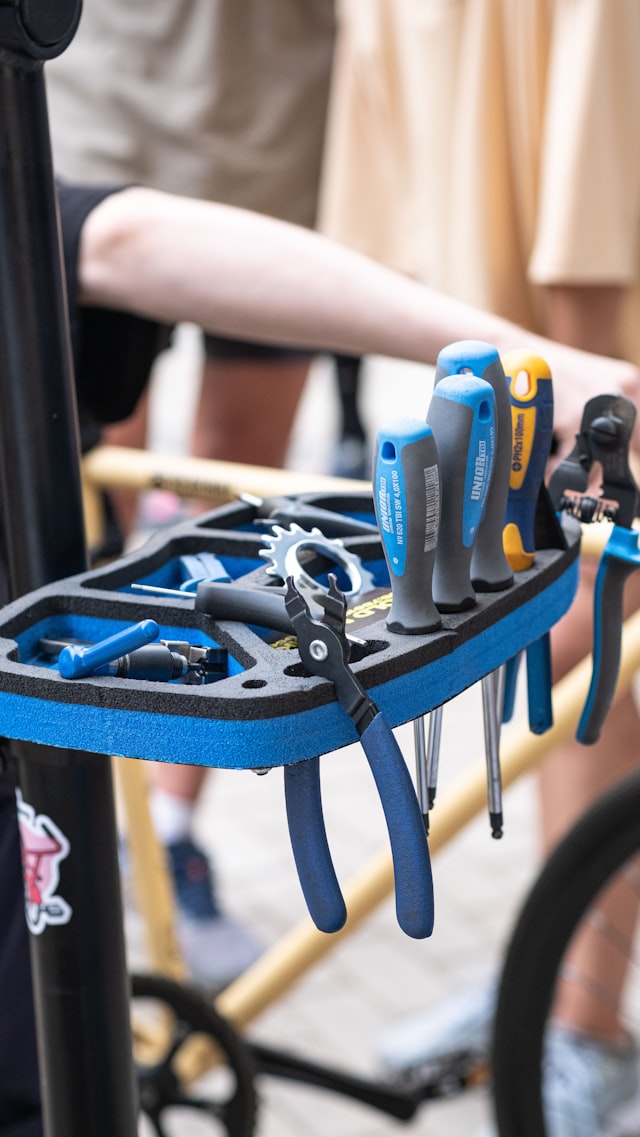
Bike tools organized on a workshop rack
PumpsFeatured

Topeak Joe Blow Sport III Floor Pump

The Joe Blow Sport III is the floor pump you find in half the garages of people who ride regularly. It has a steel barrel, a large top-mounted gauge, a stable base, and the TwinHead that fits Presta and Schrader without flipping parts. E-bike tires run low pressures compared to road bikes, so what matters is a gauge you can read at 15 to 40 psi and a head that seals on Schrader valves, and this pump does both. It is not a high-volume fat-bike pump, so a 4-inch tire takes a lot of strokes, but it will get there.

Best for: Home garage pumping · Schrader and Presta households · Riders who want a readable gauge

City bike with a backpack
Pumps

CYCPLUS A2 Portable Electric Bike Pump

Small rechargeable electric inflators have become popular with e-bike owners, and the CYCPLUS A2 is one of the common ones: set a target pressure on the digital display, screw it onto the valve, and it runs until it hits the number. It works with Presta and Schrader and also inflates car tires in a pinch. The trade-offs are battery life (a few tires per charge on larger volumes), heat after continuous use, and accuracy that is good enough for e-bike tire pressures but not lab-grade. For riders who do not want to pump by hand, it is a convenient garage and car-trunk tool.

Best for: Riders who dislike manual pumping · Car trunk or garage use · Setting precise low pressures

How to choose pumps

Valve compatibility

Check whether your tubes are Schrader or Presta and get a dual head or a head that switches automatically. A Presta-to-Schrader adapter works in a pinch but is easy to lose.

Volume versus pressure

Fat and mountain tires need a high-volume pump; narrow commuter tires need higher pressure. A general-purpose floor pump does both adequately, but fat-tire riders will appreciate a high-volume barrel.

Gauge accuracy and range

Fat tires run 10 to 25 psi, so a gauge with a clear low-pressure scale is important. Digital gauges or a separate low-pressure gauge help. Hybrid and commuter tires usually run 35 to 65 psi.

On-bike option

A mini pump with a hose, a CO2 inflator with spare cartridges, or a rechargeable electric inflator. For fat tires, electric inflators or a high-volume mini pump beat CO2.

Durability

Steel barrels and metal heads last; plastic heads crack and leak. A long hose reaches valves on bikes with fenders and racks without fighting the angle.

Maintenance tips

  • Check pressure weekly and before long rides; temperature swings shift it noticeably.
  • Keep the pump head clean and the gasket lubricated lightly so it seals without leaking.
  • Write your front and rear target pressures on a piece of tape on the pump so you do not have to remember.

Frequently asked questions

What pressure should I run in my e-bike tires?

Start with the range printed on the tire sidewall and adjust within it for your weight and terrain. Fat tires often sit around 15 to 25 psi on pavement; commuter tires around 40 to 60 psi. Heavier riders and cargo loads go toward the upper end.

Schrader or Presta: which does my e-bike have?

Look at the valve. Schrader is the wider car-style valve with a spring pin; Presta is narrow with a small threaded nut you unscrew before pumping. Most U.S. e-bikes use Schrader, but check before buying a pump head.

Can I use a gas-station air compressor?

On Schrader valves, yes, carefully. Compressors deliver a lot of air fast and fat tires reach their maximum quickly. Add a little at a time and check with your own gauge.

Is a CO2 inflator enough for a fat tire?

A single 16 gram cartridge typically will not fully inflate a 4 inch tire. Carry larger cartridges or two, or use an electric inflator or mini pump instead. CO2 also leaks out within a day or two, so re-inflate with air at home.

More accessories categories