Frisco E-Bike

Maintenance

Torque Wrenches

Preset and adjustable torque tools for axle nuts, stems and rotors.

Torque matters more on an e-bike than on most bikes. The frames and components see higher loads, hub-motor axle nuts must be tight enough to resist motor torque without stripping the dropouts, and the consequences of a loose stem or rotor bolt at 25 mph are worse than at 12. A torque wrench replaces guesswork with a number you can check against the spec printed on the part, and once you own one you will wonder how you ever tightened a stem by feel.

E-bike fasteners cluster into two ranges. Small bolts on stems, handlebar clamps, seat clamps, brake calipers and rotor bolts are typically 4 to 10 Nm, with many stem bolts at 5 to 6 Nm and rotor bolts around 6 Nm. Larger fasteners, mainly hub-motor axle nuts, crank bolts and some thru-axles, run 30 to 50 Nm or more; many hub motors specify around 40 to 50 Nm at the axle nuts. No single affordable tool covers both well, so most owners end up with a small preset or adjustable wrench for the cockpit and brakes, and a larger wrench for axle and crank work.

Preset torque keys set to 5 or 6 Nm are cheap, accurate and cover the most common bolts; an adjustable 2 to 25 Nm wrench with hex and Torx bits handles everything at the small end. For axle nuts, a 10 to 80 Nm click wrench with the right socket is worth having, especially if you remove the rear wheel for flats. Whichever you buy, use it correctly: approach the click smoothly, do not keep pulling after it clicks, and store the wrench wound down to its lowest setting.
1 products

Shop torque wrenches

Open a product for our full notes, pros and cons, and the link to its Amazon listing. We do not sell or ship products ourselves.

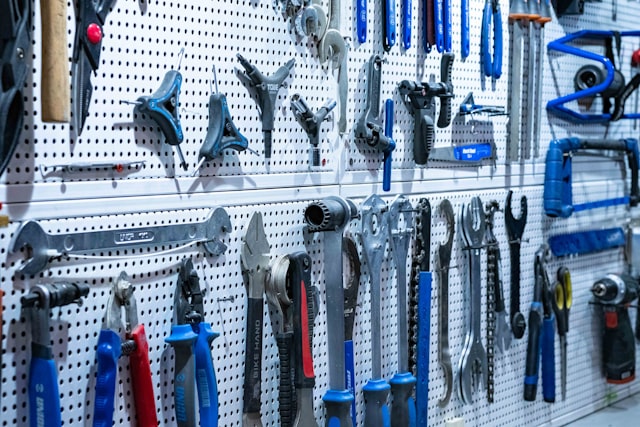
Tools hanging on a repair shop wall
Torque Wrenches

Pro Bike Tool 1/4-Inch Drive Click Torque Wrench Set (2–20 Nm)

Pro Bike Tool's set is the popular value choice: a 1/4-inch drive click wrench covering 2 to 20 Nm, a set of hex and Torx bits, an extension and a case. The range is wider than the Park TW-5.2 and covers cockpit, brakes, rotor bolts and many rack and accessory jobs. Accuracy is fine for home use; it is not a calibrated lab tool. The case keeps the bits together, which is most of the battle. For e-bike owners who want one affordable torque wrench, this covers the majority of bolts they will touch. Reset it to the minimum after use.

Best for: First torque wrench · Cockpit, brake and rack bolts · Riders who want bits included

How to choose torque wrenches

Torque range

A small wrench covering roughly 2 to 25 Nm for cockpit, brakes and rotors; a larger wrench covering about 10 to 80 Nm for axle nuts and cranks. Match the tool to the fasteners you will actually turn.

Preset versus adjustable

Preset keys at 5 or 6 Nm are foolproof for the most common bolts. Adjustable click wrenches cover more but cost more and need care. Beam wrenches are accurate and cheap but harder to read.

Bit and socket coverage

Hex 3 to 8 mm and Torx T25 cover most small fasteners; axle nuts need 18 or 19 mm sockets or whatever your hub uses. Check that the bits are hardened and fit snugly.

Accuracy and calibration

Look for a stated accuracy, typically within a few percent, and a tool from a maker that sells calibration. Cheap wrenches drift; stored wound down they last longer.

Handling

A clear audible and tactile click, a readable scale, and a comfortable handle. For axle nuts, enough length to reach the torque without straining.

Installation considerations

  • Find the torque spec printed on the component or in the manual before tightening; when in doubt, use the lower end.
  • Tighten multi-bolt clamps in a cross pattern in small steps to the final torque.
  • Pull smoothly to the click, stop, and do not re-click repeatedly; that over-tightens.

Frequently asked questions

What torque should hub-motor axle nuts be?

Most hub motors specify somewhere around 40 to 50 Nm, but it varies by maker. Check the motor or bike documentation. Under-torqued axle nuts let the axle spin and damage the dropouts; over-torqued ones strip threads.

Do I need a torque wrench for stem and handlebar bolts?

Yes, especially with carbon bars or a heavy bike. Stem bolts are usually 5 to 6 Nm, which is easy to exceed by hand. A preset 5 Nm key is cheap insurance.

What about rotor bolts?

Typically about 6 Nm with a T25 Torx, with thread locker. Over-tightening strips the small threads; under-tightening lets the rotor creep and loosen. Tighten in a star pattern.

Is a cheap torque wrench accurate enough?

Reasonably, for bike work, if stored correctly and not abused. Preset keys from reputable makers are usually within a few percent. If you rely on one for axle nuts, check it against a known tool occasionally.

More maintenance categories