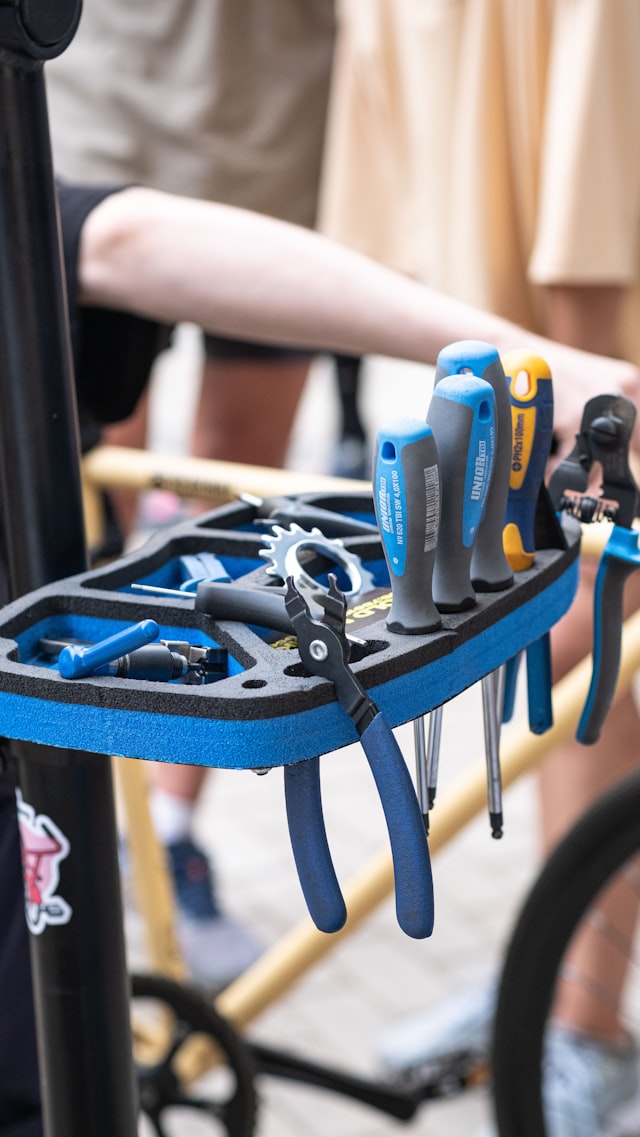
Rotor truing forks, pad spreaders, bleed kits and caliper alignment tools.
Brakes on an e-bike work harder than on a pedal bike, and they need attention more often. A heavier bike at higher speeds heats rotors, wears pads faster, and makes a slightly bent rotor or a misaligned caliper a constant rubbing irritation. Most of the common brake problems are fixable at home with a handful of inexpensive tools, and doing the work yourself also tells you when a problem is beyond simple adjustment.
The basic kit: a rotor truing fork to straighten small bends, a pad spreader or plastic lever to push pistons back before fitting new pads, and hex and Torx bits to loosen and re-tighten the caliper bolts for alignment. A caliper alignment tool, which is a thin spacer that slides over the rotor, makes centering the caliper easier than squeezing the lever and hoping. Isopropyl alcohol and clean rags for rotor cleaning belong in the same drawer.
Hydraulic brakes add a bleed kit matched to your brake's fluid: mineral oil for many commuter e-bike brakes, DOT fluid for some others, and never mix them. Bleeding is approachable with the correct kit and the maker's procedure, but it is messy and fluid on pads ruins them, so work carefully. Many e-bike brake problems are simpler than they look; our troubleshooting page on brake rubbing walks through the checks, and if the lever goes to the bar, a brake is leaking, or the motor cutoff sensors misbehave, an E-Bike Assessment or a shop visit is the safer path. Brake work is also where a torque wrench pays for itself: caliper and rotor bolts have small specs that are easy to overshoot.