Frisco E-Bike

E-Bikes

Hunting E-Bikes

Quiet, high-torque fat bikes with racks and trailers for backcountry access.

A hunting e-bike is a fat-tire bike tuned for getting a person, a pack and eventually a load of meat or gear deep into terrain quietly and without spooking game or burning a morning on foot. Compared with an ATV it is near-silent, leaves less scent and track, and is allowed in many places motorized vehicles are not. Compared with walking, it extends how far you can hunt from the truck and makes the haul out far less painful. The bikes that do this well share a few traits: high-torque motors, 4-inch tires, strong racks, and the ability to pull a trailer.

Motor choice is the big fork in the road. A 750W to 1,000W rear hub motor is quiet, simple and handles flat to rolling terrain well; it struggles on steep, soft climbs with a loaded trailer because it cannot use the bike's gears. A mid-drive motor multiplies torque through the drivetrain and climbs far better under load, but it is louder in some designs, wears chains faster, and tends to cost more. Look at the stated torque figure (Nm) rather than watts — that is what matters when you are dragging a quarter out of a creek bottom. Battery capacity should lean large: cold mornings, mud, low tire pressure and a trailer all eat range, so a 48V or 52V pack of 700Wh or more, or a dual-battery option, is a reasonable target.

Finally, know the rules before you ride. Public-land e-bike access varies by state, by agency and sometimes by individual wildlife management area; some treat e-bikes as bicycles, others as motor vehicles, and some prohibit them on trails entirely. Texas state lands, national forests and private leases each have their own policies, so confirm before you plan a hunt around the bike. Matte or camo finishes, a quiet motor and a rack that does not rattle are nice touches, but legal access and a bike that will not strand you in the dark are the priorities. If your hunting bike has started cutting out under load, an E-Bike Assessment beats discovering the problem three miles in.
4 products

Shop hunting e-bikes

Open a product for our full notes, pros and cons, and the link to its Amazon listing. We do not sell or ship products ourselves.

Electric bicycle parked on a sidewalk
Fat Tire E-BikesFeatured

Aventon Aventure.2 Fat Tire E-Bike

The Aventure.2 is a full-size fat-tire bike that feels more refined than most of its direct competitors because of its torque sensor and the way the 750W motor is tuned. Fenders, a rear rack and integrated lights are standard, and the 720Wh battery is a step above the 672Wh packs common in this class. It is a heavy bike, well over 70 lb, and the 4-inch tires add drag on pavement, so it is not the right pick for a pure commuter. For gravel, dirt roads, a little sand and rough Texas chip-seal, it is one of the best-rounded options sold through Amazon.

Best for: Gravel, dirt roads and park trails · Riders who want one bike for pavement and rough stuff · Heavier riders who want a stout frame

Man riding an e-bike down a street
Fat Tire E-BikesFeatured

Rad Power Bikes RadRover 6 Plus Fat Tire E-Bike

The RadRover is the fat-tire e-bike most Americans have seen in person, and the 6 Plus is its most refined version: a 750W rear hub, a 48V 14Ah semi-integrated battery, hydraulic brakes, a suspension fork and a dual display, in step-over and step-through frames. It is a heavy, comfortable, predictable bike that handles gravel, grass and sand and carries a rack full of gear. Rad's strengths are a large parts and accessory ecosystem and a long track record. It uses a cadence sensor and costs more than newer direct-to-consumer rivals with similar specs, but resale and support are better than most.

Best for: All-terrain recreation · Riders who want a proven platform · Accessory-heavy setups (racks, baskets, trailers)

Rider on an electric bicycle on a paved road
Hunting E-Bikes

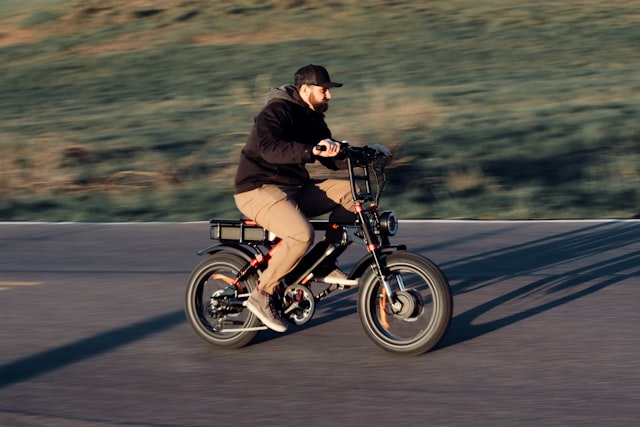
Freesky Warrior Fat Tire E-Bike

The Freesky Warrior is a 26x4 fat bike marketed at hunters and off-road riders, and it sells on Amazon at a fraction of what dedicated hunting-bike brands charge. It uses a high-output 48V rear hub system with a large-capacity battery, a suspension fork, a rear rack and hydraulic brakes on current versions. It is heavy, torquey and built for dirt roads, ranch trails and hauling a pack, not for refined pavement riding. Support is online-only and build quality is mid-tier, so it suits a handy owner. For budget backcountry access with a rack it is a reasonable alternative to much pricier hunting bikes.

Best for: Hunting access on private land · Ranch and dirt-road riding · Hauling gear on a rack

Rider on a white and black electric bike
Fat Tire E-Bikes

Lectric XPeak 2.0 Fat Tire E-Bike

The XPeak 2.0 is Lectric's full-size 26x4 fat bike, built for dirt roads, ranch property and rough trails more than for commuting. It pairs a 750W motor with a 48V 14Ah battery, a torque sensor, a suspension fork and hydraulic brakes, and it is offered in step-over and step-through frames. It is priced well below the Aventure.2 and RadRover while matching most of their spec sheet. It is heavy, the small stock battery suits shorter rides, and support is direct. For a capable off-road fat bike at a budget price it is a standout.

Best for: Dirt roads and property riding · Light hunting use with a rack · Riders who want a torque sensor cheaply

How to choose hunting e-bikes

Torque and motor type

Look at the Nm figure: 80 Nm or more is a practical floor for steep, loaded climbs. Hub motors are quieter and simpler; mid-drives climb better with a trailer. Pick based on your terrain, not the wattage on the sticker.

Battery capacity and cold performance

Cold weather can cut range meaningfully, and mud and low pressure add drag. A 700Wh or larger pack, or a dual-battery option, keeps a margin for the ride out. Keep the battery warm in the truck until you start.

Racks, trailer hitch and load rating

Confirm the rear rack rating (ideally 60 pounds or more), a front rack option, and that the rear axle or frame can accept a trailer hitch. The total system rating should cover you plus gear with room to spare.

Tires and puncture protection

26x4 tires roll over deadfall better than 20x4; either should have a puncture-resistant casing. Mesquite and cactus punish thin tires, so tubeless or sealant-filled tubes are worth considering.

Noise and finish

Geared hub motors and well-tensioned racks are quiet; direct-drive hubs hum and loose racks rattle. Camo or matte finishes are cosmetic but do help in a blind.

Brakes

Hydraulic discs with 180mm to 203mm rotors are appropriate for descending with a loaded trailer. Four-piston calipers are worth it if your country is steep.

Maintenance tips

  • Rinse mud off the drivetrain and brakes after every outing; dried mud grinds chains and pads.
  • Check trailer hitch bolts and rack hardware before each ride — rough ground loosens everything.
  • Never charge a cold-soaked battery; bring it to room temperature first to protect the cells.
  • Carry a plug kit, pump and a spare tube sized for your tire; a flat in the dark is the most common hunting-bike failure.

Advertisement

Frequently asked questions

Are e-bikes legal on public hunting land?

It varies widely. Some federal and state lands treat e-bikes as bicycles on designated trails, others classify them as motor vehicles, and some wildlife areas ban them. Check the specific agency and property rules before your trip.

Hub motor or mid-drive for hunting?

Hub motors are quieter, cheaper and fine for flat to rolling ground. Mid-drives climb far better with a loaded trailer because they use the bike's gears. If your country is steep or you haul heavy, mid-drive; if it is flat and quiet matters most, hub.

How much can a hunting e-bike carry or tow?

Total system ratings of 300 to 400 pounds are common, with rear racks around 50 to 75 pounds. Trailers typically carry 100 pounds or more, but the bike's motor torque and brakes limit how much you can realistically haul on grades.

How far will it go on a cold morning with a trailer?

Plan for half the advertised range or less. Cold, mud, low tire pressure, a trailer and throttle use all compound. Keep the battery warm until departure and ride at moderate assist on the way in.

Is a 1,000W motor legal?

Many states, including Texas, define e-bike classes with a 750W limit; bikes above that may not qualify as e-bikes on public roads and trails. Where you ride and what the land manager allows matters more than the sticker.

More e-bikes categories